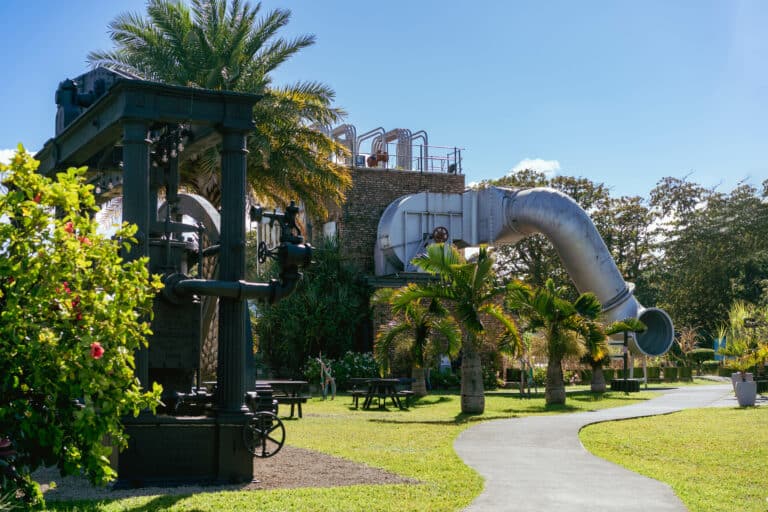




A landmark building in the city of Beau Plan, L’Aventure du Sucre welcomes around 100,000 visitors each year. As a custodian of the island’s sugarcane legacy, the museum also bears witness to the vibrant past of the entire region. Let’s take a closer look.
A fertile agricultural past
The Beau Plan estate, originally known as Forges de Mon Désir, was established in 1745. Initially dedicated to refining saltpetre used in gunpowder production, it evolved over time, adapting to the island’s changing needs and shifting global market trends. In 1776, an indigo plant was introduced at Beau Plan. “Indigofera, a small shrub then cultivated on the island, was used to produce a highly prized blue dye in Europe—through a delicate and complex extraction process,” explains Sandrine d’Unienville, Manager – Cultural Development & Communication at L’Aventure du Sucre.
However, competition from Bengal indigo eventually overshadowed the local crop, paving the way for sugarcane to take over—a crop that would go on to enjoy resounding success. “From 1794 onward, sugarcane cultivation took hold at Beau Plan. A sugar mill was founded in 1797, and by 1823, nearly 200 arpents were entirely devoted to the crop,” she continues.
Over the decades, the factory evolved and modernised. Sugar production skyrocketed from 300 tonnes in 1853 to 26,588 tonnes in 1963—proof of the quality and scale of production. After 202 years of operation, the mill finally closed its doors.
The end of an era, the preservation of memory
In a move to centralise the sugar sector, the machinery came to a halt in 1999. “That year, a severe drought hit, drastically reducing harvests and forcing the mill to close earlier than expected,” recalls Louis Denis Koenig, Administrative Executive at Terra. It was a powerful and emotional moment for everyone involved. “I remember the final end-of-year mass held in December 1999, with all the staff gathered inside the mill for a farewell ceremony. It ended on a deeply moving note with the song Con te partirò,” he adds.
Though the museum project, originally envisioned by Adolphe Vallet at Constance-La Gaieté already existed, Beau Plan stepped in after the factory’s closure to offer its site and preserve the island’s rich industrial sugar heritage. “This vibrant space honours the men and women who shaped its story, while also tracing the agricultural, economic, and social evolution of Mauritius,” notes Edwige Gufflet, Managing Director of the museum. More than just a memorial, L’Aventure du Sucre has become a key player in heritage preservation.
Beyond historical conservation, the museum is also committed to environmental stewardship, having adopted a sustainability charter. “We host numerous creative, community-based workshops centred on recycling throughout the year, as well as temporary exhibitions exploring vital themes like the environment, marine life, biodiversity, and energy,” concludes Sandrine. A place where heritage and sustainability meet—deeply rooted in history, and firmly focused on the future.