



Exploring how architecture shapes a more positive, productive, and healthy work environment.
 Work shapes people. But space shapes how they work. Most conversations around employee wellbeing have long focused on the human side: empathy, trust, mental health, psychological safety. But there’s another layer that’s often overlooked: the built environment. The buildings, the open spaces, the lunch rooms. The air they breathe, the light they work under. The flow of space, which either restores focus and attention or wears it down, shaping how we think, connect, and perform. Because here’s the truth: no one can feel well (or perform well) in a space that erodes their energy before the day begins. And you can’t ‘yoga’ your way out of an office designed for distraction.

Work spaces, though often silent, are never neutral. And companies are realising more and more that supporting people starts with supporting the environments they work in, wielding architecture as a strategic tool for enhanced well-being and in turn increased productivity.
Buildings are increasingly being recognised for their role in enabling care, focus, connection, and productivity — with placemaking at the heart, centred on the human experience.

Spaces centred around people.
Placemaking, coined in the 1960s by urbanists Jane Jacobs and William H. Whyte, begins by asking better questions: “How do people feel here?” “How can this place serve its people better?” At its core, it’s about crafting special rhythms that work in sync with human behaviour, making space a collaborator in wellbeing and performance.
How employees really feel at work in 2025
Here’s what a recent MillerKnoll study of global employees revealed:
-only 58% say their mental wellbeing is good or excellent at work
-45% feel similarly about their social wellbeing
-42% report feeling burned out at work
-Employees experiencing burnout are 3.4× more likely to look for a new job within a year
Wellbeing in motion
Off the motorway from Port-Louis to the North, stands The Strand offices, a thoughtfully-designed office development by the lake, within Beau Plan. Conceived with South African urbanist Nathan Iyer and developed by Novaterra, the Beau Plan masterplan creates an equilibrium between life and work, a vision made tangible with The Strand.
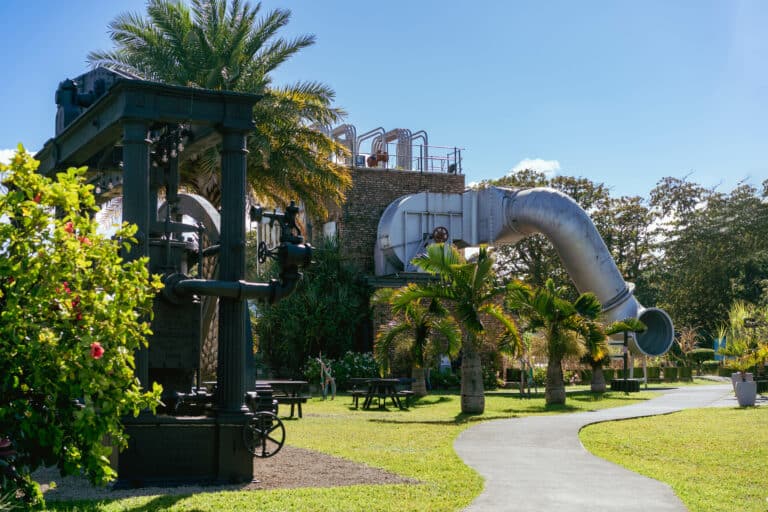
 Modern offices sit alongside tree-lined walkways and storied historic structures. From your desk, it’s a short walk to groceries, a shaded bench for a phone call, or coffee with colleagues. Even the ruins of an old sugar mill at L’Aventure du Sucre have been preserved, rooting the space in memory. The result? A landscape that restores and allows for mindful pauses. Where people can catch a breather without disconnecting from the flow of work.

Where history and greenery provide both calm and continuity, softening the edges of a workday with natural textures and sensory details.
The Strand: a space conceived with intent by Architects’ Studio
The Strand which earned the ‘Best Office Architecture in Africa’ in 2024, is built with one core principle: putting people first. The starting point wasn’t the shape of the building, but rather the human experience. For Pierre Yves Serret, Principal Architect and Director at Architects’ Studio, that philosophy is deeply tied to the ability to create calm, clarity, and focus through the language of brick and mortar. He recalls a quote by Frank Lloyd Wright: “Simplicity and repose are the qualities that measure the true value of any work of art.” “Should one adhere to this principle,” Pierre Yves adds, “the rest should naturally follow.” In the context of architecture, simplicity is about clarity, removing friction in how space is experienced. Repose speaks to calm and balance, the ability of a space to ground its occupants. That belief shaped the very foundations of The Strand, placing people and their wellbeing at the core of every decision. Here’s how that principle comes to life:
- Visual anchors for calm
Every office opens onto views of the Beau Plan lake or mountains, giving occupants moments of visual clarity throughout the day. - Natural light, generous and grounding
Light enters deeply, creating a sense of openness and comfort that supports alertness and ease.
- Wide and intuitive circulation
Pathways are designed for fluid movement, removing friction, creating rhythm.
- Greenery with purpose
Mature and intentionally-curated plants flow into the workspace, softening the environment through biophilic design. - Smart cladding
The façade helps manage heat without blocking brightness, boosting thermal, visual, and acoustic comfort.
- Nature as a design partner
Biophilic principles were part of the blueprint from day one, supporting focus, wellbeing, and sensory balance.
In fact, at The Strand, sustainability and wellbeing go hand in hand, designed to care for both people and the planet. It is Novaterra’s first project to achieve the EDGE certification, marking a major step for Beau Plan in green-certified workspaces. EDGE (Excellence in Design for Greater Efficiencies) certification requires buildings to demonstrate at least a 20% reduction in energy use, water consumption, and embodied energy in materials. For companies, it means building sustainably without compromising on user comfort. For occupants, it means working in spaces that feel better, day after day.
The measured impact of wellbeing at The Strand
- Up to 41% less energy consumption
A cooler, more comfortable indoor climate throughout the day - Over 20% improvement in resource efficiency
Spaces that support both the planet and the people in them
- Roof insulation and optimal orientation
Stable temperatures that enhance focus and reduce fatigue
- Low-flow water fittings
Responsibly designed washrooms that don’t feel restrictive
- Low-consumption lighting systems
Bright, efficient lighting that’s easy on the eyes
From design to site: how architects put people first
Did you know…
- That Architects’ Studio is an award winning architecture firm that holds employee wellbeing within their ethos?
- That their internal structure streamlines work, reduces friction, and brings clarity to daily operations within teams?
- That their team benefits from regular wellbeing initiatives, including onsite massages, internal rituals, and a collaborative rhythm that supports focus and flexibility?
- That their approach to architecture begins with the human experience at its core and every project is shaped to support how people actually live and work?
- That employee wellbeing was included in the blueprint of The Strand from day one during design discussions with Novaterra?
Today’s work represents an ecosystem that requires more than sporadic wellness campaigns to ensure its employees are well taken-care of: thoughtful architecture, intention rooted in their designs and companies seeing people as the centre of that very ecosystem. Because when space supports people, people support the work.
 Follow us on LinkedIn : Work in Beau Plan for more interesting industry news.
Written by Jyoti Punjabi for Beau Plan.